Wednesday, 3 November 2021

A fisherman’s dream for a sustainable fishing industry

27 October 2021 | TUNA PACIFIC

MV Penzella berthing outside the Honiara harbour. Photo: Tovolea Photography

HONIARA – Across the Pacific region, sustainable fishing is crucial in such an unprecedented time, and if tuna and other sea resources are not properly managed, future generations will be affected socially and financially.

In the Solomon Islands, despite the fact that the fishing industry is the second-largest revenue earner behind logging, sustainable fishing is an issue that needs the combined efforts of the government, stakeholders and people to deal with.

At the moment, it is common in many coastal communities that overfishing is drastically increasing. This is evident given the rise of undersized fish that are sold daily in fish markets throughout the country, especially the Honiara Central Market, Gizo Market and Auki market.

According to fish vendors at the three fish markets, due to the pressure faced by families to put food on the table in recent times and the need to stock up fish at the local markets, fishermen are travelling out daily to fish.

Observing the scenario above, the Wantoku Ocean Development company is now stepping into the scene to address the need and challenges faced by fishing communities around the Solomon Islands.

Samples of the vacuumed fish meats ready to be sold at the domestic market. Photo Bernard Fiubala/Wantoku Ocean Development

Business owner Bernard Fiubala is the man behind the initiative, and it was his dream business – he had a vision to purchase sustainably harvested marine products from local fishing communities in Solomon Islands and to also help them financially.

With his dream and the wish to make it a reality, from his own pocket, Fiubala saved up enough money to buy a SBD$2 million [USD$248,000] fishing vessel to achieve his dream business.

It is understood that Fiubala is the only local seaman that is currently venturing into a new  fishing business as most fishing vessels operating in the Solomon Islands are foreign owned.

Recalling the fisher’s challenges and the dream

Born and raised in Honiara, Solomon Islands, Mr Fiubala has been involving in the fishing industry for the past 25 years.

A group of local fishermen in their OBMs during one of the Wantoku Company's fishing trips. Photo: wantoku Ocean Development/Bernard Fiubala

He hails from Malaita province, and his mother is from the famous Langalanga Lagoon in Malaita, near Auki. The Langalanga people are regarded as the people of the sea due to their close relationship with the ocean and their setting.

In a recent interview, Fiubala jokes that his love for fishing and the ocean can be traced back to his mother’s people.

“Fishing is part of my life since childhood,” he says.

He recalls his early years, when he used to go out fishing with his uncles.

“When I was in my childhood, I used to go out and fish with my uncle.

“I have seen the struggle my uncle and the fishermen from my village are facing, growing up. Those days were difficult days and going out in the ocean trying to catch tuna, we often come across a lot of challenges,” Fiubala recalls.

He says he has witnessed some of these challenges firsthand, for instance, when they travelled from Auki to Honiara to sell their catches enduring life threatening boat trips.

Considering the challenges growing up as a fisherman with a rich fisheries background, Fiubala says he has seen the need to venture into this fishing business and to help the fishermen around Solomon Islands access a much bigger market.

Bernard Fiubala (second from left) when he was the Marshall Islands Marine Resources Authority Observer Advisor. He was pictured here with his observers (Meli the incoming, and Manua the outgoing), reviewing the accommodation with the second mate. Photo Francisco Blaha

“Looking at those poor fishermen when they are struggling to earn money, I proposed this idea after returning from the Marshall Islands. With the 25 years of experience, I thought of bringing something that would make a lot of fishermen produce quality and sustainably harvested fish/tuna and other marine products.

“That was the whole idea that I came up with.

“The Company wants to mine the gold in the ocean [fish/tuna] in a sustainable manner so that these sea resources can sustain us from generation to generation,” he adds.

Fulfilling the dream: harvesting the ocean’s gold

Since the arrival of his fishing vessel Penzella in 2019, Fiubala and his men have been busy engaging in the fishing business with local fishing communities in certain parts of the Solomon Islands.

To ensure that the aims and vision of the company to practice sustainable fishing is achieved, Mr Fiubala says they have signed agreements with fishing communities around the country.

“To fulfil my dream and company’s vision, we have established working relationships with a number of fishing communities we visited.

Chiefs of the Malaita Outer Islands with Mr Fiubala (second from left, in front) after agreeing to an MoU signed with Wantoku Ocean Development. Photo Bernard Fiubala/ Wantoku Ocean Development

“So far, we have signed about 50 Memorandum of Understandings [MOUs] with these communities and they have agreed to work with us,” he states.

Fiubala says the 50 agreements signed covers communities from the Western; Renbel; Guadalcanal; Central Islands; and Malaita, especially the Malaita Outer Islands (MOI).

He also visited the Malaita Outer Islands group and met  with the Chiefs, who were very supportive of the initiative.

“They liked the idea of us going down and buying fish from them, as it gives them the opportunity to hastily exchange fish for cash to sustain their daily living.”

At one stage in the Russell Islands, Central province, Fiubala says he fished with the people of Loun Community for two nights and paid SBD$30,000 in fish purchases.

For the two nights, they have caught 3.5 tonnes of fish and the money goes straight into the hands of the people of the local community.

In 2020, Wantoku Ocean Development acquired licence to fish and work with the communities of four provinces.

Despite acquiring licences for the four provinces, the company kept on receiving requests for trade from communities around Solomon Islands. But Fiubala says he can only manage four provinces and might involve the other provinces later.

COVID-19 challenges and future plans

As the COVID-19 pandemic is affecting his business, Fiubala says they had to stop their normal operations in August 2020.

However, Fiubala’s Wantoku Ocean Development was very fortunate to receive some assistance from the national government through the Economic Stimulus Package (ESP).

“The economic stimulus package has played a major role in assisting the Wantoku Ocean Development to continue with its operations, after we stopped operating since August 2020. It is good to see that the government recognise the struggles of the business with such financial support.

A female worker of Wantoku Ocean development displaying a fish they bought from a local fisherman during one of their routine trips to the provinces. Photo Bernard Fiubala/Wantoku Ocean Development

“Just recently we did a trip under the ESP. But the trip was too short as the ESP funds allocated was nowhere close to the original submitted proposal,” he says.

Fiubala says he only received SBD$140,000 from the government’s ESP and about 50% of the fund have been spent on materials that are needed to keep the business running.

Even though the company is facing difficulties in staying afloat in such an unprecedented time, Fiubala says they are looking to expand their operations in the not-too-distant future.

By December 2021, he says Wantoku Ocean Development is planning to open a fish market in Honiara.

“That’s not a realistic idea but we want to push to have the fish market operational. The company want to push to have a very decent market that sells very high–grade catches of fish that can be stored for a longer period,” Fiubala concludes.

Fiubala sees the vast Solomon Islands waters as a floating goldmine for the wide variety of fishes in the ocean.

Tuesday, 2 November 2021

Depleting fishing grounds and the need to practice sustainable fishing at Titiana

12 October 2021 | 

In various coastal villages around Solomon Islands, the use of passive devices to fish are common in the past. Photo: Wilson B. Saeni/World Fish (SI)

HONIARA, Solomon Islands – The dual impacts of over-fishing and climate change appear to have resulted in the depletion of fish stocks on various common fishing grounds used by local fishermen from Titiana village, in the Western province of Solomon Islands.

Titiana is a coastal community of Micronesian decent, situated at the southern shore about 2 miles west of Gizo, the province’s capital town.

In response to poor catches, villagers are now looking more at revisiting their old fishing methods to ensure that their fish and marine resources are sustainably managed.

As populations have grown, fishing in nearshore and coastal waters has, in some areas, lead to depleted resources and changes in fishing practices.

Common fishing grounds are no longer as rich in fish stocks, and fishing communities find it more difficult to cope with reduced catches that take more time and effort. This is increasingly an everyday challenge for many communities in the Solomon Islands.

With the daily challenges of trying to meet their demands for fish to eat, the local fishers of Titiana have now started to take sustainable fishing practices seriously as they begin to respond to concerns that their community’s main food source is on the brink of collapse.

Wesley Misu, 27, is a fisherman from the Titiana Community. In a recent interview, Misu said sustainable fishing was not a question of concern for many years. But now, communities are seeing the importance of fishing to their livelihood as they respond to declining catches despite their increased efforts.

With the complications surrounding the increase in over-fishing at the Titiana community, the fishermen are now eager to understand how sustainable fishing works.

Different sizes of tuna being sold at the Gizo Market. Photo George J Maelagi

The experience: depleting fishing grounds and over-harvesting

For the past 20 years, Misu joined his relatives and friends on fishing trips, and has  seen and experienced the changes brought about by over-harvesting of fish stocks.

During an interview at the Gizo Fish Market, Misu said it is much more difficult than 20 years ago as people have to go out very far to fish and sometimes come back home with only few fish. At times, their catches are not enough to feed their families or to be sold for little income at the market.

“In recent years, fishers would return home with less than 20 fish. This is different from the experience of the early 2000s, where we usually travel out fishing and return with a boatload of fish or tuna.

“I believe that, before, good catches were a result of careful harvesting of fish stocks in our common fishing grounds, using the traditional fishing techniques and also with the use of right fishing gear which also contributes to sustainable fishing,” said Misu.

Another challenge that the young fisher said he is experiencing now is the impact of climate change on the movements of fish stocks from their common fishing grounds.

Misu said sometimes when he goes out to fish, he returns with nothing at all.

“Maybe this is caused by the rising tides or how the tides are changing each day.”

Wesley Misu showing a tuna that was caught at an industrial FAD located in oceanic waters south of Gizo. Photo George J Maelagi.

In spite of all the challenges Misu and the fishermen from Titiana are facing today, they never give up exploring the reefs and deep seas to fish.

They said they see a lot of potential in fishing because it benefits their families over the passing years.

“Fishing has always benefited us in all aspects of life. I would be unemployed or broke it wasn’t for fishing—or if there is no ocean, we wouldn’t fish.

“Therefore, we have to keep our ocean and fish in sustainable ways so that our future generations can enjoy eating from our sea resources like now,” Misu and the group of fishermen explained.

Another issue raised by the fishers as a contributing factor to the depleting fishing grounds was the use of small gillnets to fish in the reefs and near Fish Aggregating Devices (FADs). With the small sized gillnets, it is common knowledge there is a possibility that most unwanted fish species and other marine lives will be caught as bycatch.

“That said, people need to have a clear understanding of the fish population and the extinctions of other fish and marine species, and also choose carefully which type of fishing method they can use,” the fishers stated.

Apart from the accounts of the Titiana fishers, the fishing community of Gizo also reported that people are using all kind of fishing methods, especially in the technological age. In doing so, they are contributing to the over-harvesting of some endangered fish and marine species.

This does not only affect the fish, but also the reef’s ecosystem.

Besides, almost every day people went out to the sea to fish, so they are well versed with the behavior of the fish and the locations of the fishing grounds. This makes it difficult for them to fish at the same spot because of the repetition of harvesting on the same fishing ground every day.

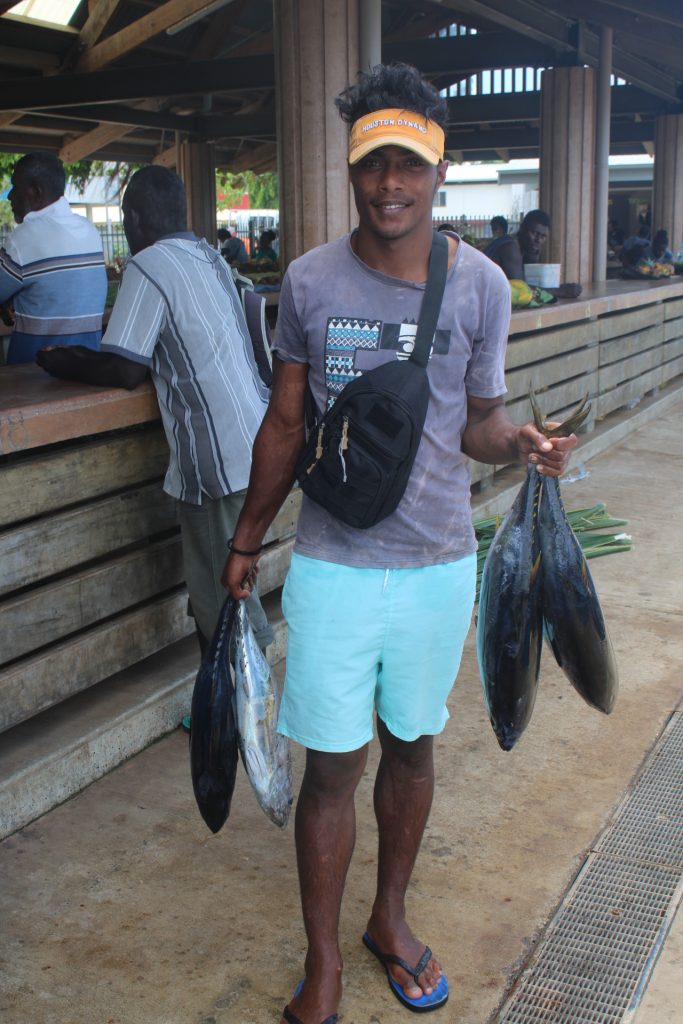
Young man holding 4 tuna standing near a market
A young lad returns with his day’s catch to be sold at the Gizo fish Market. Photo George J. Maelagi.

Finding the solution to create a local, sustainable fishery

In various coastal villages around Solomon Islands, traditional ways of fishing using throwing or shooting devices (spears, bow and arrow, throw nets, spear-guns) or passive devices (fish-traps, gillnets, fish-pens) were used in the past.

For the Titiana fishing community, the Kura fishing method began long ago, especially since the mid-1950s when the first settlers of the community migrated from Kiribati, between the 1950s and the early 70s while Solomon Islands was a British protectorate.

Others have also stated that Kura is a local name for deep-sea fishing, with lure hooks and a white plastic shank, that has been done for several years. This method is said to have been introduced by Filipino (Philippines) fishers.

The Kura fishing technique is an old-fashioned way of fishing which Misu and other fishermen from his village have been recently trialing to see if it can contribute to sustainable fishing.

Misu explains how the Kura fishing works.

“I first went on a Kura fishing trip two decades ago when I was a kid. Back then, I used to go out on fishing trips with my uncle or sometimes with my friends.

“This method (Kura) is a very easy way to fish because you use coconut leaves attached to a rock and drop your bait to the bottom of the ocean to attract the fish.

“After dropping the fishing line, you will just wait to pull the tuna or fish when you feel that it bites the bait,” Misu explains.

Kura is a simple fishing technique, but the size of the fishing line and hook determines one’s catch.

Another old fishing method is toe-line fishing. According to Misu, this type of method is less dangerous for juvenile fish because one can only catch normal sized fish.

Interestingly, both the Kura and toe-line fishing can also be used in offshore and inshore fishing. These methods are also used to catch tuna near deep-sea FADs.

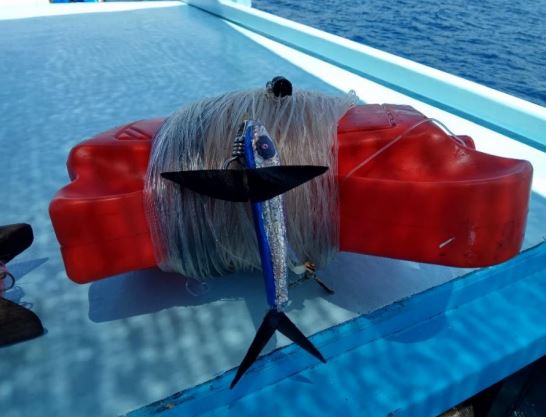
A lure attached to a hand line, rolled up on the deck of a boat
Example of a handline and lure used for surface trolling and kite fishing for yellowfin tuna

Realising the importance of FADs for a sustainable fishery

As fishing is the only means of income generating activity for the Titiana coastal community, the use of FADs is seen as a crucial way to manage fish population.

“The people here are heavily dependent on our sea resources. This is due to our ocean fishing skills, and our lack of land and expertise for gardening – the other main food and livelihood option in rural Solomon Islands,” Misu said.

It was also reported that offshore fishing can be dangerous for Titiana fishers, due to the fact that the industrial FADs are located in oceanic waters to the south of Gizo, with fishers operating small outboard motor-powered canoes to access these FADs between 20 km and 70 km offshore. If the weather gets rough it can be dangerous, and it is also very expensive for the fuel to travel so far offshore.

“We used to travel far to fish for tuna at the industrial FADs.

“But it can be costly, especially if we went out on a trip and the catch was limited. This means making a loss, as we  need to cover the cost of fuel and other expenses incurred on that single trip,” the fishermen explained.

However, the fishers are also aware that fishing FADs offshore is  one way to manage fish population and to protect the reefs and its ecosystem from over-harvesting.

This is essential for reefs to avoid over exploitation. This way, fisherman and communities will preserve the reefs to fish for a longer time.

“The idea is basically to have more coastal and nearshore locally made FADs to attract fish after a period of time. After the FADs are launched, no one is allowed to fish at the FADs until it open for community harvest.

“That way, fish stocks in the common fishing areas will be healthy and sustainable in the long run,” the Titiana fishers said.

Children of Titiana pictured swimming in the reef that was once rich in fish and other marine produces. Photo Ronald F Toito’ona

They also encourage local fishermen around Solomon Islands and the Pacific region to practice sustainable fishing. The group of fishers stated that every fisher needs to understand how to fish properly in their respective fishing grounds. Only in this way will they have a sustainable population of fish in the ocean, from the deep to the seashores.