NORO, Solomon Islands - The Noro Port in the Western province of Solomon Islands has become the first e-port in the Pacific region, after launching a digitally integrated catch documentation and traceability scheme on 24 June.
The launch was a landmark for the Ministry of Fisheries and Marine Resources (MFMR), the local tuna industry, customs and health departments – it is the very first fishing port in the region to operate the Catch Documentation System (CDS).
For the Solomon Islands Ministry, this is a new chapter in its effort to modernise how it processes data. The formal launch of Noro e-port program no longer requires using paper to record and store data.
Speaking at the launch event of the state-of-the-art system that will make fish accountancy more efficient, the Honourable Nestor Giro, Minister of Solomon Islands MFMR described the Noro e-port project as a milestone achievement.
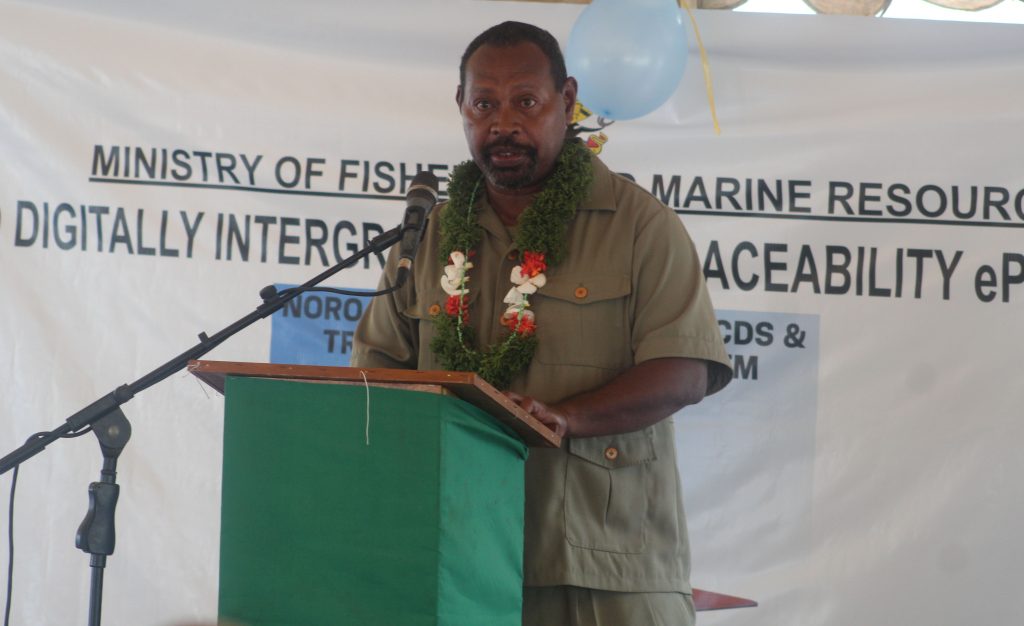
Solomon Islands Minister for Fisheries & Marine Resources, Nestor Giro delivering the keynote speech during the launch event on June 24, 2021. Photo: Francis Pituvaka MFMR.
He says the project was a concept which came about from the many challenges faced by the Ministry’s Noro-based compliance team when carrying out their duties. Their duties include implementation of national inspection and CDS requirements, which are important to support the tuna industry at Noro.
“You would recall that, in 2015, Solomon Islands was ‘yellow carded’ by the European Union for not complying with the market requirements, which implies elements of Illegal Unregulated Unreported (IUU) fishing,” says Minister Giro.
The Ministry of Fisheries and its stakeholders, which include National Fisheries Development, Soltuna and relevant government line ministries, responded by stepping up their effort to conform to the requirements of the European Union. This saw the lifting of the yellow card in 2016.
Minister Giro said it was the compliance team at Noro that worked tirelessly to ensure all requirements are met. This involved manual collection of data and information from landing to export (CDS and traceability) from paper to Excel spreadsheets, which is time consuming and requires more effort.
This gave rise to the need for a system that caters to the process of CDS and traceability.
The early development of the CDS scheme
In 2018, discussions were under way between the ministry and Dr Transform Aqorau, who was the brainchild behind the development of the new digitised system, to integrate with Soltuna, National Fisheries Development and other line ministries involved in the process of CDS and traceability at Noro Port.
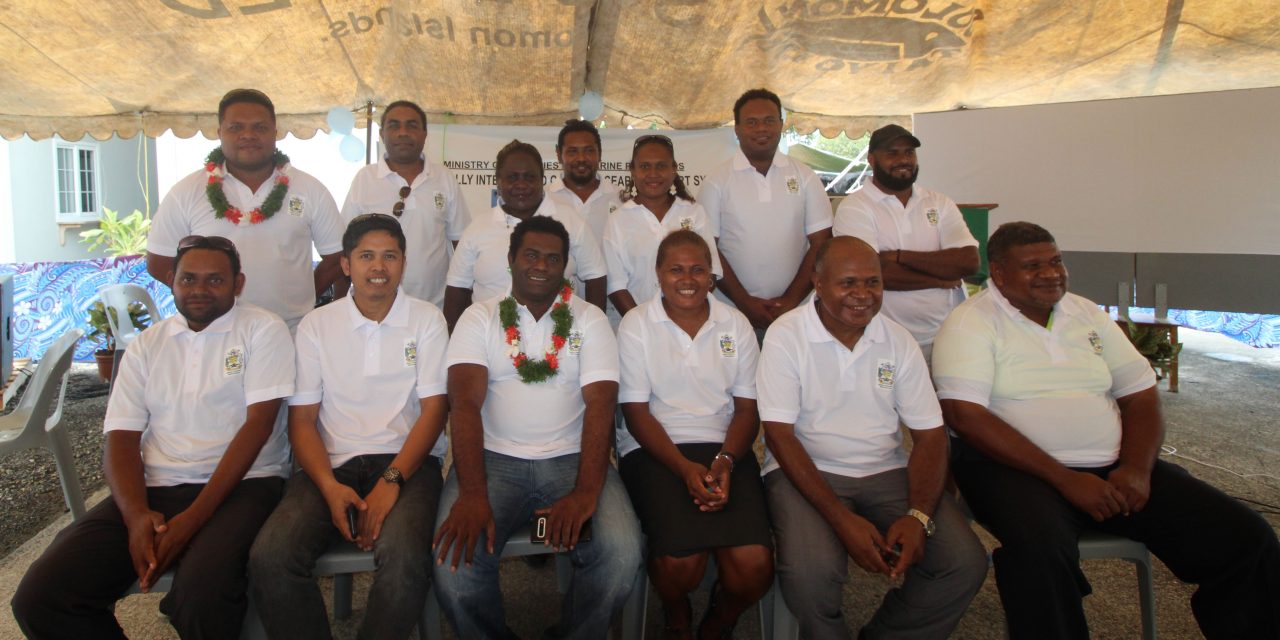
The team behind the success story of the Noro e-Port facility. Photo: Francis Pituvaka MFMR.
Funding for the phase 1 of the project was sourced from Western and Central Pacific Fisheries Commission in 2019, and in 2020 the ministry engaged iTuna Intel to deliver phase 1 of the project under the guidance of the Noro e-port committee.
According to Dr Aqorau, iTuna Intel’s CEO, the development of the system has been a truly collaborative effort between officials of the MFMR, government IT services, the tuna industry, customs, health and iTtuna Intel.
He says the energy put together in getting the project to where it is today, under the leadership of MFMR’s Permanent Secretary Dr Christain Ramofafia, has been commendable despite a few criticisms made towards the development of the system.
“There were also detractors who questioned the systems development but these made me even more determined to show that we are capable of developing a system to transform the fisheries operations at Noro,” Dr Aqorau says.
“These have all been important factors in shaping the success of the work that we are here to witness today. Perhaps we may have taken a leaf out of the book from the people from here who – in spite of the land disputes that have characterised the history of this region – have been able to arrive safely to this landmark development.”
The iTuna Intel CEO told the launch event that he is a proud man.
“I am so proud to be associated with the project through iTuna Intel, but it was colleagues in the MFMR, government IT services, the tuna industry, customs and health who made it happen to be the first. It is just the beginning and we look forward to more strategic partnerships to build on what has been developed using local resources. We want to have smart ports, and to do that we must invest in our people to embrace emerging technologies to better manage our fisheries.”
Dr Aqorau said the Solomon Islands tuna industry is fortunate that its partners appreciate the importance of having a comprehensive digital traceability system to monitor the legality of their products ‘from catch to plate’. They, more than anyone, appreciate the value of being able to demonstrate that they fish sustainably and legally – this is what the global tuna market demands.
“The Solomon Islands Government also has coastal and port state responsibilities to ensure the fisheries are sustainable and that fish landed at Noro is not caught illegally. Thus, there is a mutual interest that the government and the industry share in making Noro a smart port – the ‘Port of Tomorrow’ –that has a transparent fit-for-purpose traceability system which would allow for full accounting of the fish landed, processed and transshipped through Noro,” Dr Aqorau says.
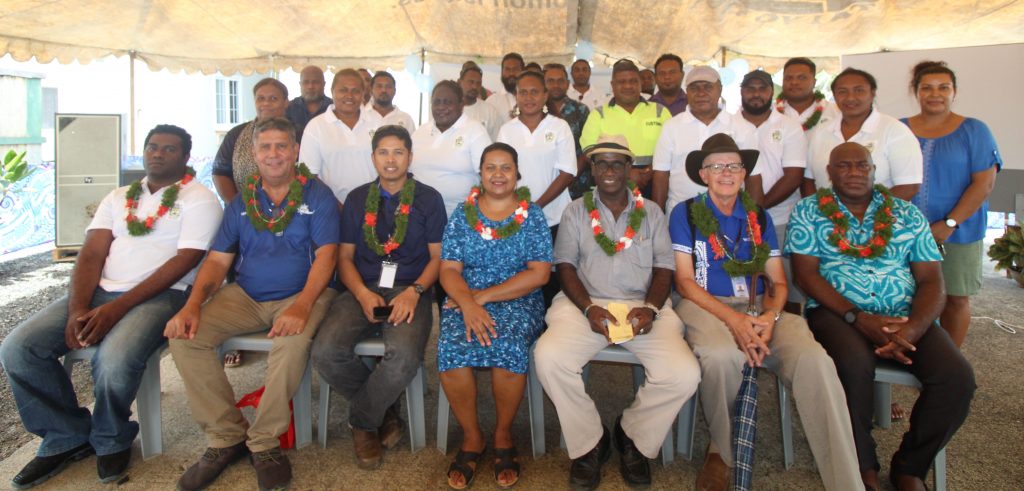
Those who attended the launching. Missing are the Minister Hon Nestor Giro and Permanent Secretary Dr. Christain Ramofafia. Photo: Francis Pituvaka MFMR.
New CDS is a home-grown system, developed locally
During the ceremony, Minister Giro also acknowledged the new CDS as a home-grown initiative which was developed without any outside technical assistance.
Dr Aqorau also revealed in his speech that the origins of the project may be traced to a discussion on the floor of the first fisheries office at the Noro Town Council premises between key stakeholders about how they can improve and streamline the processes at Noro.
“The investments in the e-Port have taught us many things, but the most important is that it is ‘our system’, entirely developed as a home-grown system that we have built on our own – and for that, Minister, we can all be proud and deserve to celebrate the occasion,” he says.
“No one else, to the best of my knowledge, has built an integrated digital traceability system for a fishing port, and therefore I fervently believe that the time we have spent on building the system makes us just as competitive as any other developers in the world.”
Dr Aqorau says COVID-19 has therefore been a blessing in disguise, in a sense, “because it has made us reach deep within the means that we have to build a fit-for-purpose system which transforms Noro into a smart fishing port, a fishing port that sets the benchmark for the application of the best international [standards] that can withstand any independent audit.”
According to Minister Giro, the launch marks the completion of phase 1 of the project, which “includes the administrative work between government’s [IT services] and MFMR to identify a developer, develop a system, and test and trial the e-port system”.
“Trials of the system have been done and now we will witness how data is being transferred from the port into the system using this cutting-edge technology,” the Minister says.
Minister Giro had also revealed that phase 2 talks are currently underway with FFA to secure their assistance towards the project.
Speaking on behalf of the FFA Director General, Director of Fisheries Operations Allan Rahari congratulated the MFMR and stakeholders for the home-grown initiative.
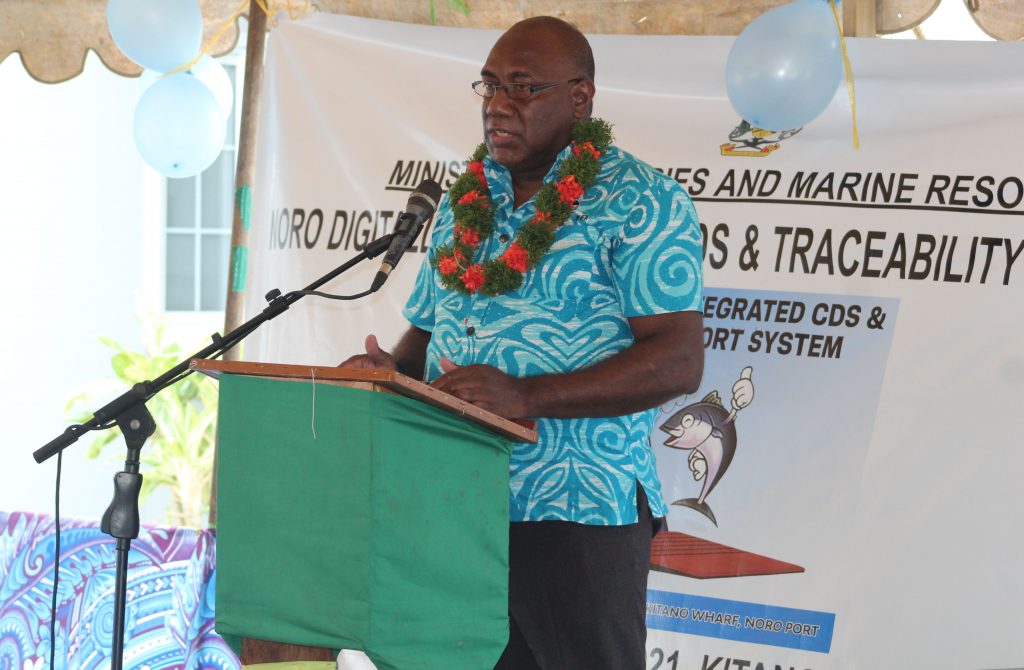
FFA Director Fisheries Operations Division, Mr Allan Rahari delivering his speech at the Noro e-Port launching on Thursday at the Kitano Wharf, Noro. Photo: Francis Pituvaka MFMR.
“The positive progress made so far has demonstrated your collective commitment to embrace technology through this paperless, interconnected and integrated e-port system capturing both port state measures and CDS activities. So, well done to the ministry and stakeholders for progressing this project to achieve the milestone we are celebrating,” Mr Rahari says.
He says he was pleased to note that the development of the project is championed by local expertise without external advisors.
“This is a significant point worth highlighting. We must recognise, acknowledge and use the expertise we have locally to our advantage. So this is one of the hallmarks of this project – the use of local expertise,” Mr Rahari says.
Mr Rahari also highlighted that the success of the project as a model, which can be replicated in other ports in Solomon Islands or the region.
“This project is a ‘model project’, as its objectives are in line with the Regional CDS Framework recently adopted by the Forum Fisheries Committee in May 2021.”
He has stated that the FFA stands ready to work with the ministry to progress the next phases of the project.
HONIARA, Solomon Islands – Solomon Islands Government has reinforced its commitment, through the Ministry of Fisheries and Marine Resources (MFMR), to the development and sustainable management of its tuna resources as a top priority – and called for the involvement of the public to make it a reality.
The Minister for Commerce, Industries, Labour, and Immigration, Fredrick Kologeto, said in an address at the World Tuna Day celebration in Honiara that the Ministry of Fisheries and Marine Resources (MFMR) would take the lead.
Mr Kologeto spoke on behalf of the fisheries minister, Nestor Giro.
“It is the ministry’s belief that with a sustainable tuna resource we will continue to benefit from the use of this resource: as food on our table, as a cash crop to meet our families’ socio-economic needs, and as an export commodity to support the needs of our country,” Mr Kologeto said.
“Collectively, it remains our duty to ensure that our people receive maximum economic and social benefits from our tuna resources.”
Mr Kologeto called for public support from citizens to take responsibility in managing the country’s tuna resources as everyone’s business.
“The responsibility to manage this resource in a sustainable manner is entirely on us. We are all in this together.
“As stakeholders in this important resource, let us align our commitments towards ensuring sustainability of our tuna stocks. Let us all work together to achieve this,” Kologeto told the gathering on 6 May.
He said that increasing demand for tuna globally meant the resource needed to be sustainably managed.
“This is important, as our country makes a lot of revenue from this resource, and because of this resource many of our people can be employed. This is evident in the fishing and processing sector,” Mr Kologeto said.
“Many of our people can be fed and many of our people can earn a living. Tuna, indeed, is a source of food and livelihoods to our many coastal communities.”
He said that MFMR was “delighted” to see current development and sustainable management of the tuna resources in Solomon Islands.
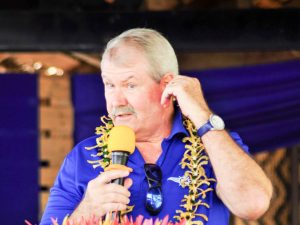
Addressing people at Honiara’s World Tuna Day 2021 were, left to right, Minister for Commerce, Industries, Labour, and Immigration, Fredrick Kologeto; Tuna Industry Association of Solomon Islands’ Russell Dunham; and FFA’s Allan Rahari. Photos: Ronald Toito’ona.
FFA acknowledges cooperation in sustainable tuna management
Pacific Islands Forum Fisheries Agency (FFA) Director of Fisheries Operations Allan Rahari, in his speech at the World Tuna Day event, drew attention to the power and success of regional cooperation.
“FFA members should be proud of our collective actions to sustainably manage the four key tuna stocks in the region,” Mr Rahari said.
The four economically important tuna are bigeye, yellowfin, albacore and skipjack tuna. In the most recent assessments on tuna populations in the WCPO, the Pacific Community (SPC), which leads the assessments, reported that all four species were considered to be in a healthy, sustainable state, as none were considered to be overfished.
“This can be attributed to the cooperation across the FFA membership. It has led to many successes in managing our fishery, including through times of crisis such as the current extraordinary times. I wish to acknowledge Solomon Islands Government, the Ministry of Fisheries and Marine Resources, which has played a key role in this,” Mr Rahari said.
Mr Rahari said value of tuna caught in the Western and Central Pacific Ocean (WCPO) by the national fleets of FFA’s totalled US$1.7 billion. This made up 29% of the total value of the catch in the WCPO.
“The catch value taken from FFA members’ waters has increased to 49%, and this contributes to growth in government revenue from access and licence fees to US$550 million in 2020. This is mainly driven by the purse seine fishery. Work remains to address underperformance in the longline fishery,” Mr Rahari said.
Tuna industry commends regional fisheries bloc
Tuna Industry Association Solomon Islands (TIASI) spokesperson Russell Dunham said that the tuna industry in Solomon Islands had continued to flourish because of close working relationships between the main fisheries organisations in the region and local industry.
Mr Durham acknowledged MFMR, FFA, the Parties to the Nauru Agreement Office (PNAO), and stakeholders such as SPC for their lead in maintaining healthy tuna fisheries in the country.
“The industry in the Solomon Islands continue to develop over the years mainly as a result of the money from the tuna resources, and because the industry works really closely with an active ministry of fisheries in Solomon Islands,” Mr Dunham said.
“The industry acknowledges that we have the support of FFA stationed in Honiara, which has been helping the Pacific region in the sustainability of our tuna resources.
These organisations and the Western and Central Pacific Fisheries Commission had been helping the industry by providing the foundation on which the industry operated.
“Fortunately, that task [that we work at] allows the industry to develop, because we do have a sustainable fishery,” said Mr Dunham, who is also a National Fisheries Development employee based in Honiara.
Solomon Islands was very fortunate that all four tuna species were present in its waters.
“Solomon Islands is also very fortunate that we have all three major commercial ways of catching tuna: the purse seine, longline, and pole-and-line fishing. There are not so many Pacific Island countries that are fortunate to have access to these.”
He said it was important to manage tuna well across the region because it was a migratory resource.
“Sustainable management of tuna resources is important not only for the country but for the industry as well,” Mr Dunham said.
He said TIASI was looking forward to developing the industry further by enhancing the value of tuna as a resource that was often undervalued in terms of what the local industry could do with it in the global market.
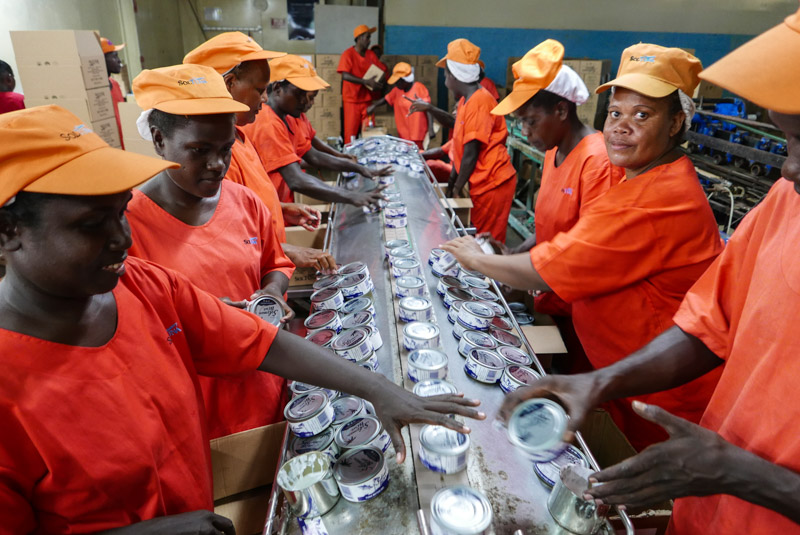
Solomon Islands fish workers in the canning line. Photo: Francisco Blaha.


 Those who attended the launching. Missing are the Minister Hon Nestor Giro and Permanent Secretary Dr. Christain Ramofafia. Photo: Francis Pituvaka MFMR.
 FFA Director Fisheries Operations Division, Mr Allan Rahari delivering his speech at the Noro e-Port launching on Thursday at the Kitano Wharf, Noro. Photo: Francis Pituvaka MFMR.